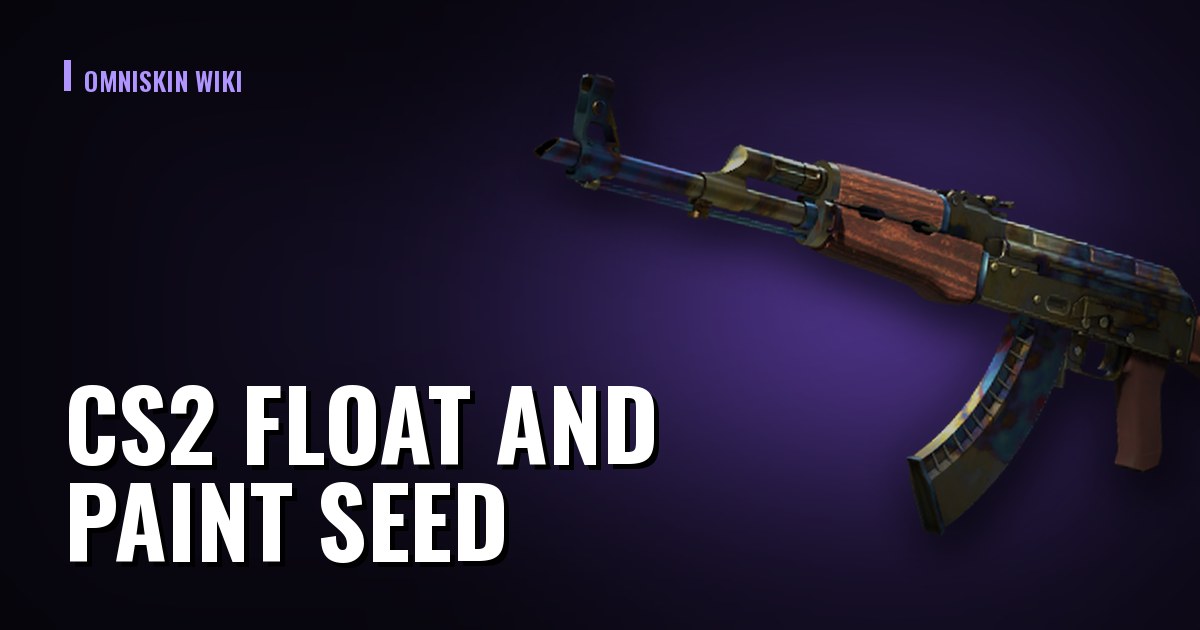
CS2 Float and Paint Seed: How They Change Price
Float sets the wear, paint seed sets the pattern, and the Doppler phase comes from paint_index. Tables, top blue gem seeds, and how to check a listing.
Two skins that look alike and share the same name can differ in price by tens of times. Two independent numbers are responsible — float (wear) and paint seed (how the pattern landed on the model) — plus a third one that people usually forget: paint_index, which is what actually sets the Doppler phase. Here is what affects what, and how to read your own values.


Float: a wear number from 0 to 1
The float value is a fraction between 0.00 and 1.00, assigned to an item the moment it is created and never changed afterwards. The lower it is, the cleaner the skin looks: near zero the texture is sharp and unscuffed; closer to one you get scratches, fading and bare metal.
The condition — that suffix in the item name — is derived from the float:
| Condition | Short | Float range |
|---|---|---|
| Factory New | FN | 0.00–0.07 |
| Minimal Wear | MW | 0.07–0.15 |
| Field-Tested | FT | 0.15–0.38 |
| Well-Worn | WW | 0.38–0.45 |
| Battle-Scarred | BS | 0.45–1.00 |
One detail causes half of all beginner questions: every skin has its own range of possible values. Valve sets a float floor and a float cap for each skin, and they are often not 0.00–1.00. That is why some skins do not exist in Factory New at all, and others never appear in Battle-Scarred. If an item is missing in the condition you want, the reason is usually not rarity — that copy simply cannot exist.
Why a low float costs more
Prices are not uniform inside one condition. A copy at the edge of the range is a separate product:
- Position inside the condition. An FT at 0.16 is visibly cleaner than an FT at 0.37, though the names are identical. On popular skins the price difference runs into tens of percent.
- Extreme values. Copies near a skin's absolute minimum ("low float") are prized by collectors and sell at a clear premium.
- Meme floats such as 0.0000000x are a niche of their own, where the price comes from the rarity of the number rather than from how the skin looks.
Steam shows only the condition. The float-aware venues — CSFloat, Skinport, Buff163, Market.CSGO — display the number, and their sellers price it in. So the easy finds are narrower than the legend: listings on venues that hide the value, copies whose value comes from the seed rather than the float, and sellers who copied the going price without ever opening the inspect link. That last group is large, but it is not everybody.
🔧Check float & patternfree, no sign-upWhen dirty costs more than clean
Everyone knows the "cleaner is pricier" rule, and that is exactly why the exceptions cost people money. The best known case is the AWP | Asiimov in Battle-Scarred. On this skin the paint on the scope and the barrel wears off the higher the float goes, and from roughly 0.90 the scope turns almost black. The community calls those copies the black scope, and they sell above ordinary BS examples: the demand is specifically for the filthiest ones.
 AWP | Asiimov (Battle-Scarred)best price: $66.72 · skinport
The lesson is not about one skin but about the principle: the price is set not by the number itself but by what the number does to the picture. Where wear happens to look good, the market pays for the wear rather than for cleanliness.
Steam shows only the condition. Marketplaces that know about float — CSFloat, Skinport, Buff163, Market.CSGO — display the number, and their sellers price it in. That is why easy finds are rarer than the legend promises: they live on marketplaces that hide the value, on copies where the seed decides rather than the float, and with sellers who copied a common price without ever opening the inspect link. There are plenty of the latter, but not endlessly many.
🔧Check float & patternfree, no sign-upPaint seed: where the pattern lands
The paint seed (also called the pattern index) is an integer in a range of about a thousand values (sources quote 0–999 or 1–1000), also fixed at creation. It determines how the texture landed on the weapon model: position, rotation and scale of the artwork.
The key difference from float: the seed has nothing to do with wear. Float says how scuffed the skin is, the seed says what you actually see on that particular gun. Two copies with identical floats can look completely different if their seeds differ.
On most skins the texture is uniform and the seed means nothing. But there is a family of finishes where it means more than everything else combined: Case Hardened, Fade, Marble Fade, Crimson Web and Slaughter.
Case Hardened and the blue gem
Case Hardened distributes blue, gold and purple zones at random. The more blue on the display side, the more expensive the copy; those are called blue gems. The opposite extreme, maximum gold, is a gold gem — a niche with its own demand.
The distance between an ordinary copy and a top seed is measured in multiples rather than percent: pattern premiums on Case Hardened reach hundreds or even thousands of percent over the price of an ordinary copy.
| Weapon | Top seeds | Note |
|---|---|---|
| AK-47 | #661, #387, #321 | #661 is the reference "number one", nearly solid blue on the magazine and receiver |
| Karambit | #387 | the most coveted blue gem in the game, valued in the seven figures — though no completed public sale has ever been confirmed |
| MAC-10 | #667, #114, #406 | all tier 1; the community has never settled on a single number one, because the finish lands on three separate receiver parts |
| Five-SeveN | #278 and others from curated lists | #278 is the documented number one; ranks come from community dumps |
| Bayonet | see community rank lists | no single reference seed |
A copy's tier comes from its rank by blue coverage within its own weapon: absolute values are not comparable across guns, an AK and a MAC-10 have different geometry, and the same seed number means completely different pictures on each.
 AK-47 | Case Hardened (Field-Tested)best price: $203.97 · lis
🔧Patterns: blue gem, fade%free, no sign-up
AK-47 | Case Hardened (Field-Tested)best price: $203.97 · lis
🔧Patterns: blue gem, fade%free, no sign-up
Fade: percentages that come from a formula
On Fade skins the seed decides how far the gradient travels along the model. The fade percentage is deterministic: it is computed from the seed by formula rather than judged by eye. The practical range runs from roughly 80% to 100%, and a confirmed 100% Full Fade is worth roughly +50–80% over an average copy on a mid-tier model. At the top the gap is wider: on the Karambit and the Glock-18 a full fade runs two to three times an 80% copy. The achievable range depends on the model as much as the seed — every weapon has its own UV map, so the same seed is not the same percentage on another gun.
 Glock-18 | Fade (Factory New)best price: $1339.00 · skinport
Marble Fade, Crimson Web and the rest
- Marble Fade — the prized layout is Fire & Ice: red and blue zones in the right places on the display side. There is a "true" F&I and plenty of near-misses.
- Crimson Web — density and placement of the webs matter: the more of them on the display side, the higher the price.
- Slaughter and other seed-driven finishes — local layouts such as "hearts"; demand is niche but steady.
The Doppler phase is not the seed
The most common misconception on the market: "the paint seed determines the Doppler phase". It does not. The phase is set by paint_index — a separate field on the item. Within a phase, the seed only varies the color layout, making a given copy brighter or duller.
So "identifying the phase by seed" is guesswork, while paint_index gives a definitive answer:
| paint_index | Doppler | Look |
|---|---|---|
| 415 | Ruby | solid red, top tier |
| 416 | Sapphire | solid blue, top tier |
| 417 | Black Pearl | black pearlescent, top tier |
| 418 | Phase 1 | dark tones with pink |
| 419 | Phase 2 | pink dominates |
| 420 | Phase 3 | green-blue tones |
| 421 | Phase 4 | blue dominates |
| paint_index | Gamma Doppler | Look |
|---|---|---|
| 568 | Emerald | solid green, exclusive to Gamma |
| 569 | Phase 1 | green with gold |
| 570 | Phase 2 | bright green |
| 571 | Phase 3 | dark green with blue |
| 572 | Phase 4 | gold-green |
These indexes cover the knife Dopplers from the Chroma and Gamma lines; later additions have their own blocks, and the Glock-18 Gamma Doppler, for example, runs 1119–1123.
Ruby, Sapphire, Emerald and Black Pearl cost several times more than ordinary phases. Among the regular phases, demand is usually higher for Phase 2 (Max Pink) and Phase 4, but that is fashion rather than mechanics.
 ★ Karambit | Doppler (Factory New)best price: $1008.05 · skinport
How to read your own values
All three numbers live inside the item's inspect link — the one behind the "Inspect in Game" button in your inventory or in a marketplace listing.
- Open your Steam inventory or the listing page on a marketplace.
- Copy the "Inspect in Game" link (it starts with
steam://rungame/730/...). - Paste it into the float checker — it returns float, paint seed and paint_index, and along with them the phase, the fade percentage and the blue gem rank wherever those apply.
Check before you buy, especially when a seller asks for a premium "for the pattern": paying for a rare seed without confirming it is the easiest way to overpay.
Common mistakes
- Assuming a low float is always worth more. On pattern skins such as Case Hardened the seed matters more than the wear: a mediocre seed in Factory New can easily be cheaper than a top seed in Field-Tested.
- Looking for a Factory New that does not exist. Every skin has its own float range, and some items physically do not exist in the top conditions.
- Reading the Doppler phase from the seed. The phase is paint_index; the seed cannot give it to you.
- Comparing seeds across weapons. Blue gem ranks are computed within one weapon, so the number by itself means nothing.
- Trusting the seller's screenshot. The picture may belong to a different copy; only the inspect link of that exact listing proves anything.
- Paying a "rare pattern" premium with no rank. If a copy is not in the known tiers, the markup rests on the seller's word.