The Cologne 2026 Major Shop Closes on September 29: What Happens to Prices
On September 29, 2026 Valve shuts down the IEM Cologne Major shop. We cover how the Event series differs from Ranked, why unspent tokens expire, and what actually happens to sticker prices once issuance stops — without promising a rally.
What closes, and when
On September 29, 2026 the in-game shop for the IEM Cologne 2026 Major stops working. After that date Major stickers can no longer be bought in game — only on the secondary market.
This is the first Major where Valve dropped capsules entirely. Instead of a lottery that handed you one random sticker out of a container, there is now a direct shop: you buy the exact sticker you want with tokens, at roughly one hundred tokens to the dollar. We covered the end of capsules in detail in the article on sticker capsules; this one is about what the closing itself changes.
 Sticker | Team Spirit (Gold) | Cologne 2026
 Sticker | Falcons (Gold) | Cologne 2026
 Sticker | NiKo (Gold) | Cologne 2026
 Sticker | Team Spirit (Holo) | Cologne 2026
 Sticker | FalleN (Holo) | Cologne 2026
Two series that are easy to confuse
The Major shipped two different sets, and the difference matters right now.
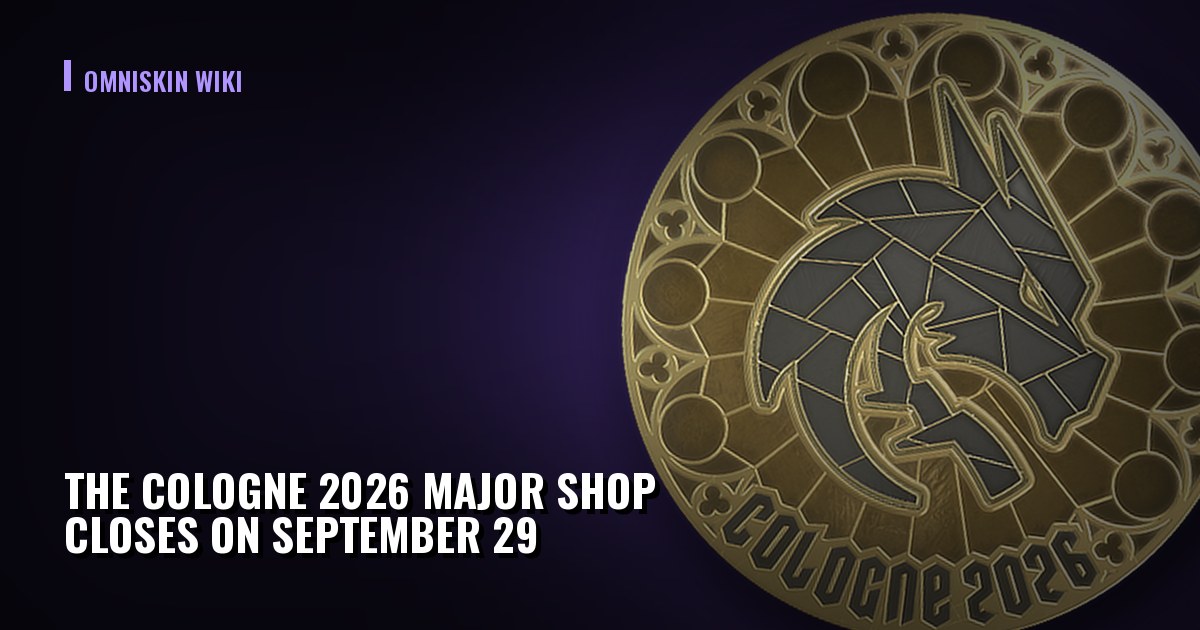
The Event series arrived on May 22, alongside the event itself. Its pricing floats with demand: the most expensive entries ran past a thousand dollars. You can recognise it by the round shape and the stained-glass background.
The Ranked series came later, on July 29, and works the other way round: fixed pricing, capped at roughly $60. The design is a square border carrying the team's final placement number. It runs to 579 stickers across 193 designs.
The contrast shows best on a single player. The NiKo champion sticker cost 4,011 tokens in the Ranked series against 98,773 tokens for its Event counterpart — roughly $40 versus $990, for the same person at the same tournament.
Tokens expire
One detail that is easy to miss: tokens you have not spent by September 29 can no longer be exchanged for stickers. They do not convert back into money and they do not carry over to the next Major. If tokens are already bought, it makes sense to spend them before the shop closes, otherwise they simply vanish.
Buying in the shop carries price-drop protection: if the price falls noticeably soon after your purchase, the difference comes back to your token balance. That protection ends with the shop — the secondary market has no equivalent.
What actually happens to prices after the shop closes
This is the part where the usual answer is "they go up." We are not going to promise that. Here is the mechanism instead.
It is true that issuance stops. After September 29 no new Cologne 2026 stickers will ever exist: the supply is exactly what people bought. That sets Major memorabilia apart from weapon skins, which keep dropping out of cases for years.
It is also true that supply only shrinks from there. A sticker has a property a skin does not: it gets consumed. Once applied to a weapon it cannot be peeled off and resold — removing it destroys it. Every sticker somebody actually used is gone from circulation for good. That is the one real supply-reduction mechanism, and it works slowly, over years.
It is not true that prices jump the moment the shop closes. Short term it often runs the other way: people who stockpiled stickers to flip them all reach the market at roughly the same time, so in the first weeks after closing the supply on marketplaces rises rather than falls. Any appreciation comes later, once that wave clears and consumption keeps doing its work.
It is also worth remembering that "Major stickers" is not one product. The spread inside a single collection is enormous: in our own database for Cologne 2026, the most expensive entry priced across several marketplaces sat at $719, while the cheapest sat at three cents — a factor of twenty-four thousand between them. Blanket statements about "Major stickers going up" apply very differently to those two items.
What to look at if you are deciding before September 29
- Gold and holo stickers of popular teams are the top of the market, priced on floating demand, and expectations are already built into them. Rarity alone does not lift the cheap end.
- The capped Ranked series behaves differently from the floating Event series: the cap limited what you paid in the shop, not what the secondary market will ask.
- The in-game price and the marketplace price are different numbers. Before buying in the shop, compare against what sellers already list — some entries are cheaper on the secondary market.
- Liquidity. Steam does not report daily volume for stickers the way it does for skins, so "will this actually sell" is judged more reliably by how many marketplaces carry the item at all than by a single price.
You can compare prices across marketplaces in our table, and look up a specific sticker through the catalogue search.
🔧Value your inventoryfree, no sign-up