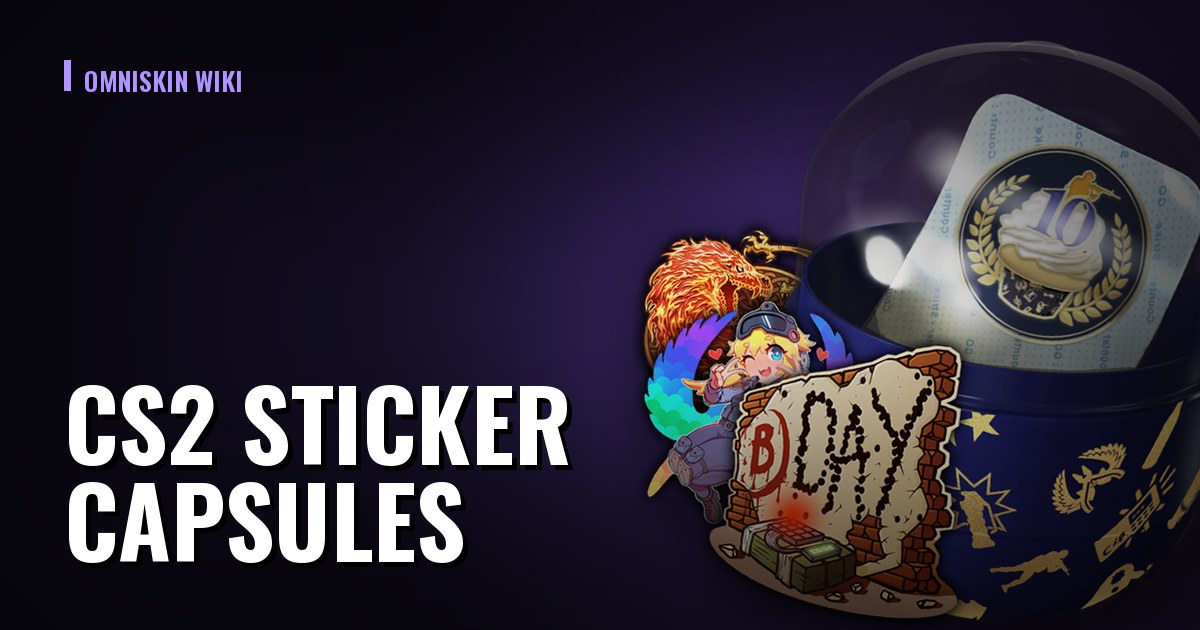
CS2 Sticker Capsules: Reading the Contents and What Changed in 2026
On May 22, 2026 Valve removed capsules from the Major and replaced them with a direct sticker shop running on floating prices. We cover how the old capsule works, why previously issued capsules are still trading, and what the new mechanic changes for a buyer.
What a capsule is and what is inside
A capsule is a container that yields exactly one random sticker from a known set. Unlike a weapon case it needs no key: a capsule opens on its own.
The sets come in two types, and the difference matters more than it looks. Team and tournament capsules hold team logos and event badges. Autograph capsules hold player signatures — a separate product with its own price logic, where what decides is not the artwork but whose signature it is and in which finish.
 10 Year Birthday Sticker Capsule
 2021 Community Sticker Capsule
 Antwerp 2022 Legends Sticker Capsule
 Antwerp 2022 Champions Autograph Capsule
 Austin 2025 Legends Autograph Capsule
Inside a set the stickers are spread across finishes: plain paper comes out most often, then glitter and holo, then foil, and gold most rarely of all. Valve does not publish capsule odds the way it publishes weapon case odds, so the only thing to lean on here is the order of rarity, not specific percentages from somebody else's table.
Running capsule maths on borrowed percentages is a bad idea. The numbers circulating on blogs often turn out to be weapon-case odds transplanted onto capsules by mistake. If a decision costs money, base it on the price of the contents rather than on unverified probabilities.
What happened on May 22, 2026
For the IEM Cologne 2026 Major, Valve rebuilt the tournament collectables system entirely. Sticker capsules and autograph capsules for the Major were removed. In their place the game gained a section where you buy the sticker you want directly, with no randomness involved.
How it works:
- purchases run on tokens, at a rate of roughly a hundred tokens to the dollar;
- each sticker's price floats with demand: popular ones get bought up and rise, interest fades and they fall;
- if the price of a sticker you bought drops noticeably shortly after purchase, the difference is returned to your token balance;
- souvenir packages were replaced too: you can now turn an ordinary skin into a souvenir version carrying gold stickers from a specific match, and it does not work on StatTrak weapons;
- the revenue split is unchanged: half goes to teams, players and the organiser, half stays with Valve.
For the market the important part is not the tokens but the disappearance of randomness. A capsule was a lottery whose contents were priced off the chance of an expensive sticker. Direct sale at a floating price removes the lottery entirely: the buyer pays for a specific item, and demand sets the price in real time.
 Stockholm 2021 Legends Sticker Capsule
 Rio 2022 Legends Sticker Capsule
 Paris 2023 Legends Sticker Capsule
 Shanghai 2024 Legends Sticker Capsule
 Berlin 2019 Legends Autograph Capsule
The old capsules did not go anywhere
The most common question after the removal is whether previously issued capsules turned into junk. The answer is no, and it can be checked with data rather than argument.
On our own showcase, three months after the removal, 195 different capsules carried live prices across several marketplaces at once. Containers issued earlier keep being bought and sold as ordinary merchandise.
More than that, the removal turned them into a closed category in the purest form. No new capsules of the old kind are being issued, so the inflow has stopped while consumption continues: every capsule opened is gone for good. This is precisely the case where supply can only shrink.
None of which means "buy capsules". What it means is that closed-collection logic now applies to them, and that logic demands you check demand rather than rarity alone.
Open the capsule's contents and look not at the most expensive sticker in the set but at the median one — that is what you get in the typical case. Add up the contents by finish and compare with the price of the capsule itself: if the capsule costs more than its typical contents, opening it is unprofitable by definition. Check how many trades clear on the capsule, not how many listings exist. In our data 91.1% of the rows on any marketplace are seller offers rather than trades. Remember that opening is irreversible: a capsule becomes one sticker and does not reassemble. If the goal is a specific sticker, work out whether buying it directly is cheaper. It almost always is.
There is a third group people forget: capsules issued not for tournaments but for general events and for the community. They are not tied to teams, their contents live their own life, and demand rests on the artwork rather than on fan attachment. For valuation that is easier: there is no "the team disbanded and nobody wants its stickers" factor.
What this changes for a buyer
The practical conclusion is simple and unkind to capsules. Opening a container to get one specific sticker is nearly always more expensive than buying that sticker. The lottery makes sense as entertainment only, and treating it as investment is a mistake: the maths of opening works against the opener by construction — otherwise there would be no reason to issue capsules.
The new system acknowledges this and removes the middle step. For a buyer who wants their favourite team's sticker it is a straight improvement: they pay for what they want and not for nineteen unwanted attempts.
For the market the consequences reach further. A floating price in the primary sale means a sticker now has an official reference point that moves with demand — and secondary marketplaces have to reckon with it. Meanwhile the old capsules have moved definitively into collectible territory: they are not produced, they are consumed, and they should be valued by trade counts.
Compare prices across marketplaces:
Before buying a capsule, ask one question: do you want the sticker or do you want to open something? Those are different wants at different prices. The first is almost always cheaper to satisfy by buying directly; the second is more honestly booked as money spent on entertainment.