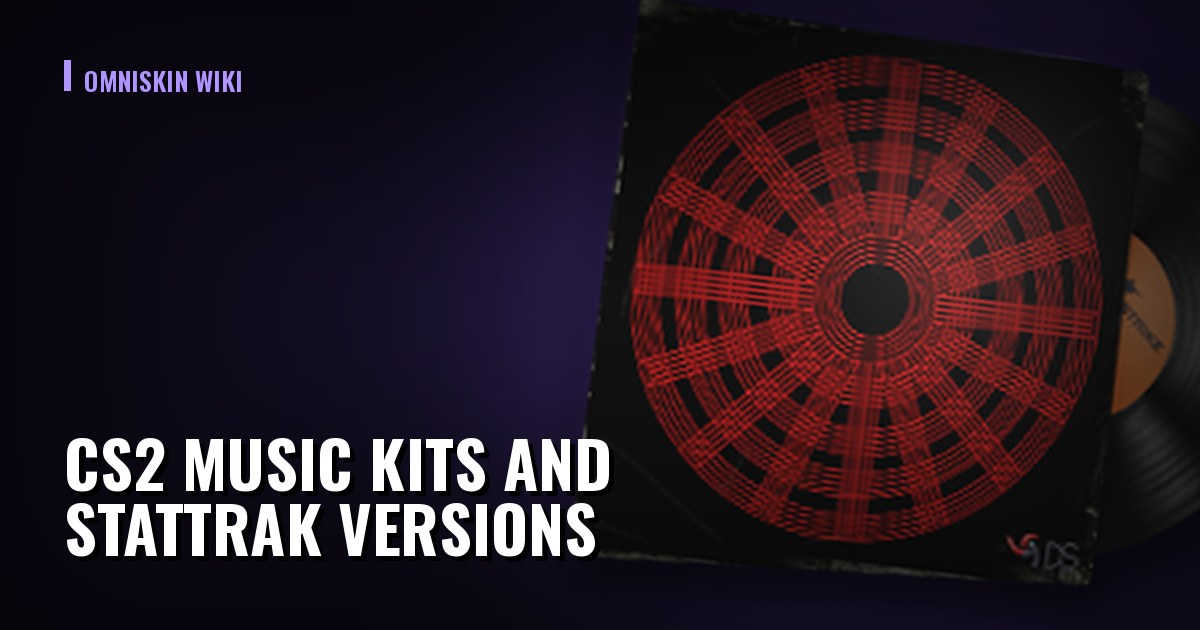
CS2 Music Kits and StatTrak Versions: How They Work
A music kit is the only item you cannot see, only hear. We cover what it actually changes in game, how the StatTrak version differs, why its counter tracks MVPs instead of kills, and how prices behave in this thin category.
The item nobody can see
A music kit replaces the game's music: the round start theme, the bomb plant sound, the ten seconds before detonation, the victory screen and — above all — the tune that plays when you are named the round's best player. It is the only category that changes no visuals at all.
Two consequences follow that nothing else on the market shares. First, a kit is worn one at a time: however many sit in your inventory, exactly one plays. Second, only the owner gets the effect of the purchase — hears it, rather. An AK skin is shown to the whole server; a music kit is shown to nobody.
 Music Kit | Daniel Sadowski, Crimson Assault
 Music Kit | Noisia, Sharpened
 Music Kit | Damjan Mravunac, The Talos Principle
 Music Kit | Robert Allaire, Insurgency
 Music Kit | Skog, Metal
On any market an item with no public display is worth less than a comparably rare item that has one. Music kits are the clean example: prices in the category are low not because kits are plentiful, but because the purchase is invisible to everyone around you.
The StatTrak version: it counts MVPs, not kills
Most music kits have a StatTrak variant, and it is built differently from the weapon one. On a rifle the counter tracks kills. In a music kit it tracks how many times you were the round MVP while the kit was equipped — that is, how many times your victory tune played.
The logic is neat: the kit records exactly the event people listen to it for. The counter only rises while the kit is equipped, it lives with the item, and it stays on it when the item changes hands.
One detail explains the market difference: the counter can only be seen by inspecting the item in an inventory. It is not displayed during a match, and an opponent will never learn about it. That is why the StatTrak premium works more weakly here than on weapons, where the counter is visible on the model.
Do not mix a StatTrak kit with the plain one when comparing prices across marketplaces. These are two different items with different names, and in a general list they sit side by side. The gap between them is not a spread and not a trading opportunity.
Where kits come from and why the market is thin
Music kits arrive by two routes. Some are sold directly in the in-game store and are therefore always available — supply for those is effectively unlimited and the price sits near the floor. Others shipped in boxes and event bundles: their inflow has ended, and they behave like a closed collection.
 Music Kit | AWOLNATION, I Am
 Music Kit | Beartooth, Disgusting
 Music Kit | Ian Hultquist, Lion's Mouth
 Music Kit | Sasha, LNOE
 Music Kit | Mateo Messina, For No Mankind
The difference between those two groups matters more than it looks. A store kit has a hard ceiling: while it is sold directly, nobody will overpay for it on a marketplace, and any asking price above the store price simply sits there without a buyer. A kit whose inflow has ended has no ceiling at all — but no floor either, since its price holds exactly as long as somebody wants that particular track. The first group can be valued against the store; the second only against trades.
Liquidity in the category is low for a reason unrelated to rarity. Music is chosen by taste, and taste converts poorly into demand: a buyer does not want "a kit for 5 dollars", they want the specific track they like. The seller's taste and the buyer's rarely coincide, so listings sit.
In our own data 91.1% of the rows on any marketplace are offers rather than completed trades. In thin categories like music kits that share is the single most important thing to understand before buying anything to flip.
Listen to the kit before buying — the game has a preview, and it is the only property of the item that matters. Check whether the kit is sold directly in the in-game store. If it is, the store price caps what marketplaces can charge. Decide whether you want StatTrak. The counter is visible only to you and only in an inventory, so the premium pays back in interest, not in looks. Compare the price across several marketplaces: in thin categories the gap between venues is often wider than on liquid weapons. If you are buying to resell, look at the number of trades in a month rather than the listing price. In this category buyers take a long time to arrive.
Is a music kit worth buying
For yourself, yes, if you like the track. It is one of the few purchases in the game where the value is honest and measurable: you listen to music you picked for dozens of hours, and it usually costs very little.
For resale it is an awkward category. A low unit price means marketplace fees eat a visible share, and infrequent trades mean a long wait to exit. An instant buyout in our measurements returns a median of 81% of the listing price, and on a cheap item that gap bites harder than on an expensive one: small in absolute money, large as a share of the sum.
There is a third use nobody usually considers: a kit as a gift. It is cheap, it does not ask the recipient to understand wear and patterns, and it does not date — the music sounds the same in a year and in five. For that role a music kit beats almost any skin at a comparable price.
The sensible exception is kits with closed inflow and a recognisable author. But they should be checked the same way as any closed collection: by the number of trades, not by the sticker price.
Work out what the whole inventory is worth:
🔧Value your inventoryfree, no sign-upIf you are torn between the plain kit and the StatTrak version, take the plain one. The MVP counter is a nice private detail, but it is invisible during a match and barely affects how fast the item sells, while the price difference is immediate.