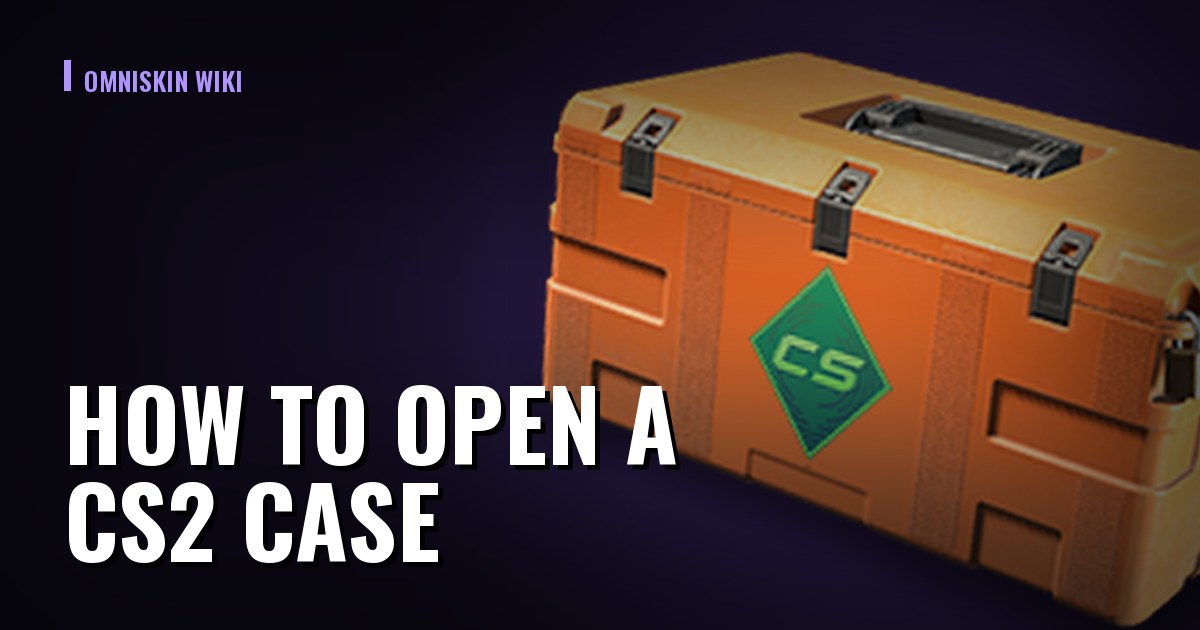
How to Open a CS2 Case: Keys, the Steps and What to Know First
A case drops for free while a key is bought — and the key has a property that makes it impossible to return or pass on. We cover the opening steps, how keys differ from one another, and three things worth checking before buying one.
What opening requires
Opening is made of two parts and both are mandatory: the case and a key for it.
A case comes free — it drops for playtime — or is bought on a marketplace for small money. A key is never free: it is purchased in the in-game store at a fixed price regardless of how expensive the case you are opening is.
Hence the first practical consequence: the cost of opening barely depends on the case. A cheap and an expensive container open with the same key at the same price, and the entire difference between them is the contents.
A key bought in game cannot be passed on, sold or refunded. That is not a time limit but a permanent property: buying a key is a final decision. The keys visible on a marketplace are old copies purchased before the rules changed.
The steps
Open the inventory section in the game's main menu and find the case. Select the case — the game shows its contents and offers to sell you a key if you do not have a suitable one. Buy the key. It is bound to a container family: a key from one family will not open another. Confirm the opening. The animation shows the result, and it lands in your inventory immediately. Check the date on the item you received from which it becomes tradable: fresh items enter a trade restriction.
How keys differ
Keys are not universal, and that regularly surprises people.
Weapon case keys fit most modern containers. These are what get bought most often.
Capsules and sticker packs need no key — they open on their own.
Old named keys from specific collections only fit their own family and do not work on modern cases.
If in doubt, do not buy a key in advance. The game itself offers the right one once you select a specific case, and that is the only reliable way not to make a mistake.


Three things to check before buying a key
What the case itself costs. If the container sells for less than a key on a marketplace — and it almost always does — the arithmetic of opening becomes visible: you are paying for a lottery, not for an item.
What can actually drop. A case's contents are visible before opening, along with their rarities. The official odds run: blue 79.92%, purple 15.98%, pink 3.2%, red 0.64%, knife or gloves 0.26%. That last figure means roughly one hit in 385 openings.
What the contents are worth. Compare a typical item from the case, not the best one, with the cost of opening. Anchoring on the top row of the list is exactly the error the whole case-opening industry rests on.
The honest arithmetic looks like this: on average an opening returns less than it costs. Otherwise issuing cases would be unprofitable, and that is not an opinion but a condition of the mechanic existing at all. Opening makes sense for the process, not for income — and treated that way it is a normal spend on entertainment.
What happens to the item you unbox
You opened it and the item is in your inventory at once — and here two surprises await a newcomer.
A trade restriction. A fresh item cannot immediately be sold or traded. The exact unlock date is written on the item itself, and since the 2026 update the term is counted per item: each thing has its own 168 hours from its own moment, with no shared daily resets.
The wear came out at random. Within the name you unboxed, the float is assigned on creation and never changes. That is why two items with the same name from two cases are worth different amounts, and the only way to see which one you got is to inspect it.
Both features explain most of the questions that follow a first opening. The item is yours immediately, it becomes money a week later, and how much money depends on a number you did not choose.
What to do with cases if not opening them
The most practical option is to sell. Cases from the active drop pool are worth pennies, but there are many of them and the total adds up. Cases withdrawn from rotation behave differently: the inflow stopped while consumption continues, so such containers appreciate over time.
A separate subtlety: selling a case gives you money, while opening one gives you an item of unknown value. The first can be counted, the second cannot. We have a detailed write-up of the opening arithmetic where this is worked through in numbers.
Compare prices across marketplaces:
If you do want to open, set the amount in advance and treat it like a cinema ticket: the money does not come back and you had the experience. Trouble starts when opening is called an investment and a return is expected.