CS2 Graffiti and Patches: Consumable vs Collectible
Graffiti gets spent and disappears, a patch sticks on forever — both categories are built so that one click destroys the item. We cover the charge mechanic, why an unsealed graffiti cannot be sold, the three patch slots, and what is actually worth buying.
Two categories built around irreversibility
Graffiti and patches share one property that is rare among skins: they can be used up. Weapons, knives and agents sit in your inventory as long as you like and can be sold at any moment. Not here — and that, rather than rarity, is what governs how they behave on the market.
Graffiti is sold sealed. While it is sealed it is an ordinary tradable item. The moment you unseal it, it turns into 50 spray charges and stops being tradable and marketable for good. Every spray spends one charge; when the charges run out the item is gone.
A patch works much the same way, except the point of no return is application. A patch goes into an agent's slot and cannot be taken back into your inventory: only deletion is available, and deleting destroys the patch.
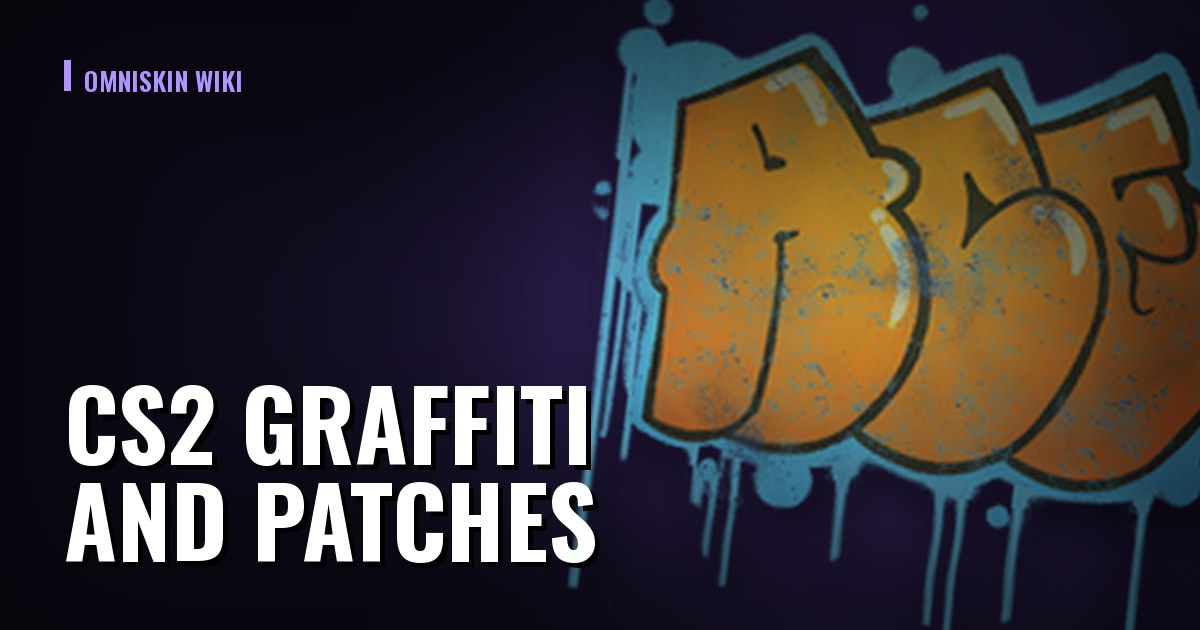
 Sealed Graffiti | Ace
 Sealed Graffiti | Kawaii Killer CT
 Sealed Graffiti | Popdog (Wire Blue)
 Sealed Graffiti | King Me (Brick Red)
 Sealed Graffiti | Recoil AWP (Brick Red)
Unsealing a graffiti "just to see what it looks like" is a one-way operation. The item goes from tradable to consumable instantly, and no marketplace will take it afterwards. Look at the artwork before buying, not after.
Graffiti: a consumable that is sometimes collected
Two very different types live inside the category, and confusing them is expensive.
Mass-market graffiti are ordinary drawings that drop in game and sell for pennies. They exist in colour variants: the same artwork comes in red, blue, green and others, and each variant is a separate item with its own price. There is exactly one practical reason to buy them — to spray in a match.
Tournament graffiti carry team logos and an event name. They were issued in limited runs for specific events, the inflow ended long ago, and people buy them not to spray but as a memento of a particular major. The same logic applies as with souvenir skins: the price is set by the event and the team, not by the drawing.
Colour variants deserve a separate word, because they are what people trip over most often when comparing prices. One drawing can exist in a dozen colours, and those are not "shades of one item" but standalone positions: each has its own price, its own trade volume and its own history. When a marketplace shows a several-fold price difference under near-identical names, it is almost always the colour rather than a find. Check the full name, brackets included.
The difference in price behaviour follows directly. Mass-market graffiti gets cheap and stays cheap: supply is enormous, and every purchase made for play removes the item from the market entirely. Tournament graffiti behaves like a collectible: zero inflow, slow burn, low liquidity, and a wide spread between marketplaces.
Consumption is what makes graffiti an unusual category: these are the only items that leave circulation en masse not into somebody else's inventory but permanently. Over time that puts a floor under the price of older designs.
Patches: three slots and one irreversible decision
Patches are applied to agents. Most models have three slots, and the exact placement depends on the operator: on some the patches show on the chest, on others on the sleeve or the back.


The economics of patches are simple and unforgiving. A patch applied to an agent leaves the market: it can no longer be sold separately, and removing it means destroying it. Which means applying an expensive patch spends its full value, it is not "an investment in the look". The resale value of a patched agent equals the value of the bare agent, with no premium.
Decide what you are buying: a patch to apply or a patch to hold. Those are different decisions with different costs of being wrong. If it is to apply, buy a cheap one. You are paying for how it looks on your own screen, and that money does not come back. If it is to hold, do not apply it at all. Sealed, a patch stays merchandise; on an agent it stops being merchandise. Before buying a second-hand agent, check whether it already carries somebody else's patches. You cannot peel them off and recover the money, and the seller's taste may not be yours. Price such an agent as the bare model: a premium for someone else's build only pays off if you happen to agree with it.
What is actually worth buying here
For play the answer is short: mass-market graffiti and cheap patches. These are consumables in the literal sense, and they should be treated as such — bought for a specific want, not "for later".
For resale the category is hard work. The unit price is low, which means marketplace fees and the minimum price step eat a visible share of it. Add thin liquidity: in our own measurements 91.1% of the rows on any marketplace are listings rather than trades, and on cheap categories that share of offers hanging without a buyer bites hardest.
The sensible exception is tournament graffiti and rare patches whose inflow has closed. Even there the rule is the one that governs any closed collection: the absence of new supply does not create demand. What you check is the number of trades, not the sticker price.
See what your inventory is worth, graffiti and patches included:
🔧Value your inventoryfree, no sign-upA simple test before buying: ask yourself whether you are willing to lose the whole amount. For graffiti and patches that is not a figure of speech — unsealing and applying write the value down to zero exactly as described.