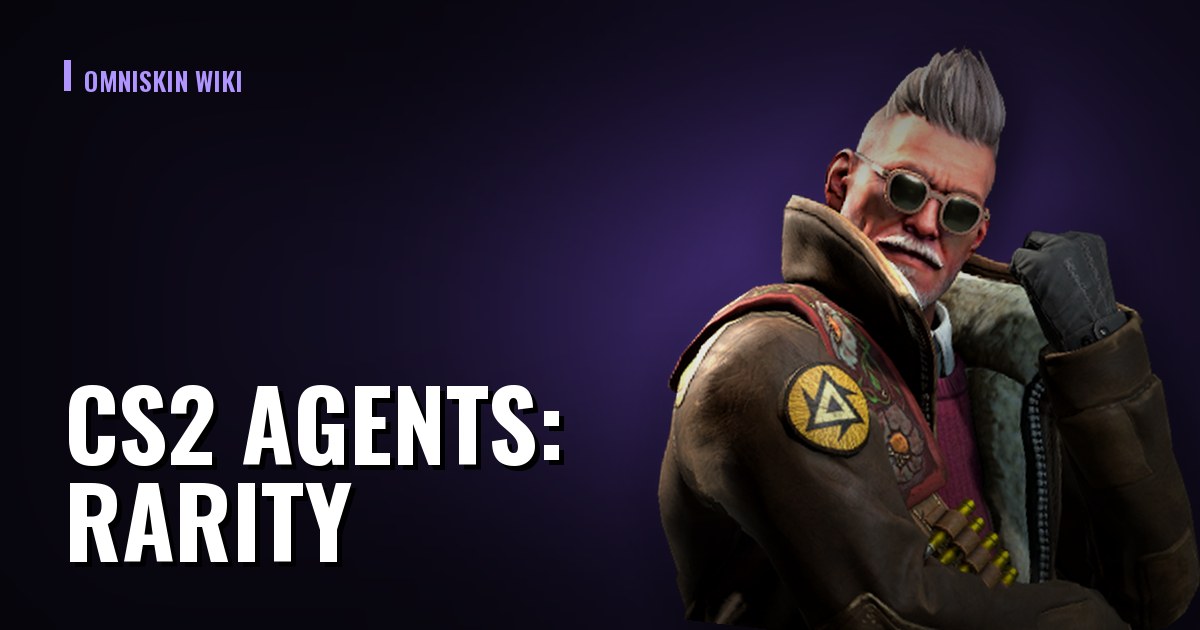
CS2 Agents: Rarity, Demand and Why They Get Cheaper
An agent has no float, no pattern and no StatTrak — the name of the item fully describes the item. We cover the four rarity tiers, where operators come from, why their prices behave unlike weapon skins, and why that makes cross-market comparison honest.
What an agent is and how it differs from a weapon skin
An agent is a character model that every player in the match can see. Unlike a skin, it does not sit on the item in your hands — it replaces the operator entirely: silhouette, clothing, face, victory voice lines. Agents entered the game with Operation Shattered Web and have been a separate market category ever since.
For the market something else matters more. An agent has no wear, no pattern and no StatTrak. Everything that defines the item fits into its name: "Sir Bloody Miami Darryl | The Professionals" is one single item, not a corridor of dozens of different copies the way "AK-47 | Redline (Field-Tested)" is.
 'The Doctor' Romanov | Sabre
 Sir Bloody Miami Darryl | The Professionals
 Cmdr. Mae 'Dead Cold' Jamison | SWAT
 Number K | The Professionals
 Getaway Sally | The Professionals
 Osiris | Elite Crew
 3rd Commando Company | KSK
 'Blueberries' Buckshot | NSWC SEAL
 1st Lieutenant Farlow | SWAT
 B Squadron Officer | SAS
Agents are locked to a side. A counter-terrorist model cannot be worn on the terrorist side or the other way round, so a full set for play is always two items, never one.
Four rarity tiers and what they actually mean
Agents have their own rarity scale, separate from the weapon one. There are four tiers, from common to rare: Distinguished (blue), Exceptional (purple), Superior (pink) and Master (red).
The scale describes how hard the model was to obtain, not how good it is. There is no straight "redder means pricier" rule: price is set by how recognisable the character is and whether it caught on. An unremarkable Master can sell for less than a popular Superior if nobody wants to wear the model.
| Rarity | Colour | What it means on the market |
|---|---|---|
| Distinguished | blue | mass tier, low prices, middling liquidity |
| Exceptional | purple | the middle, demand rests on looks |
| Superior | pink | recognisable characters, the liveliest segment |
| Master | red | the narrowest tier, higher prices and a wider spread |
Why the absence of float matters
The lack of wear and pattern has one practical consequence almost nobody writes about: comparing agent prices across marketplaces is honest.
On weapons, comparing by name lies. Under "★ Karambit | Doppler (Factory New)" live different phases with a threefold spread, and a "profitable gap" between two venues often turns out to be the gap between the worst and the best phase. On an agent that trap does not exist at all: the name is the item. If an agent is cheaper on one venue than another, the difference is real, and it comes from fees, audience or a local demand skew — not from you having compared two different things.
The flip side is a thin market. In our own data the overwhelming majority of rows on any marketplace are listings rather than trades: 91.1% of rows are seller offers. On agents that share bites harder than on liquid weapons, because far fewer buyers want any one specific model.
A low price on an agent usually means no buyer rather than a bargain. Before buying one to flip, look at the number of real trades in a month rather than the sticker price: on half the models you can count them on one hand, and there will be nobody to sell to.
Where agents come from and why supply does not grow
Operators were handed out through operations: for the pass, for completing missions, for stars. There is no case with agents in permanent rotation — which means the category has no daily inflow of new copies.
That breaks the familiar "supply grows, price falls" logic that governs case skins. For agents the inflow stopped when the operation ended, and until Valve runs another operation with operators the count can only shrink. Even so, many agents have grown cheaper over the years, and the reason is demand rather than supply: the fashion for a particular character passes, and the players who bought a model for its novelty gradually sell it on.
Hence a simple rule: agent prices are driven by interest, not by issuance. Spikes in demand come from notable updates, tournaments and videos, not from changes in how items are handed out.
The practical takeaway for a buyer is straightforward. If you are buying an operator to play with, timing does not matter — the item neither wears out nor expires. If you are buying it to sell dearer in a year, you are not betting on the model's rarity but on somebody wanting that character exactly then. That is a bet on fashion, and it looks more honest once you call it by its name.
Patches: the only way to change an agent
One detail does let you tell your operator apart from someone else's — patches. Most models have three patch slots, and where those slots sit depends on the specific agent.
Open your inventory and pick the agent you want to decorate. Take a patch from your inventory and apply it to one of the slots on the model. Repeat for the remaining slots if you want to fill all three. Remember: a patch cannot be taken back off into your inventory. It can only be deleted, and deleting destroys it for good. For that reason, do not put expensive patches on a cheap agent — you lose the value of the patch with no way to recover it.
Check what your assembled inventory is worth, agents included:
🔧Value your inventoryfree, no sign-upWhen buying a second-hand agent that already has patches applied, price it as the bare agent: you will never sell those patches separately. A premium for a "nicely assembled" set is pure overpayment for someone else's taste.