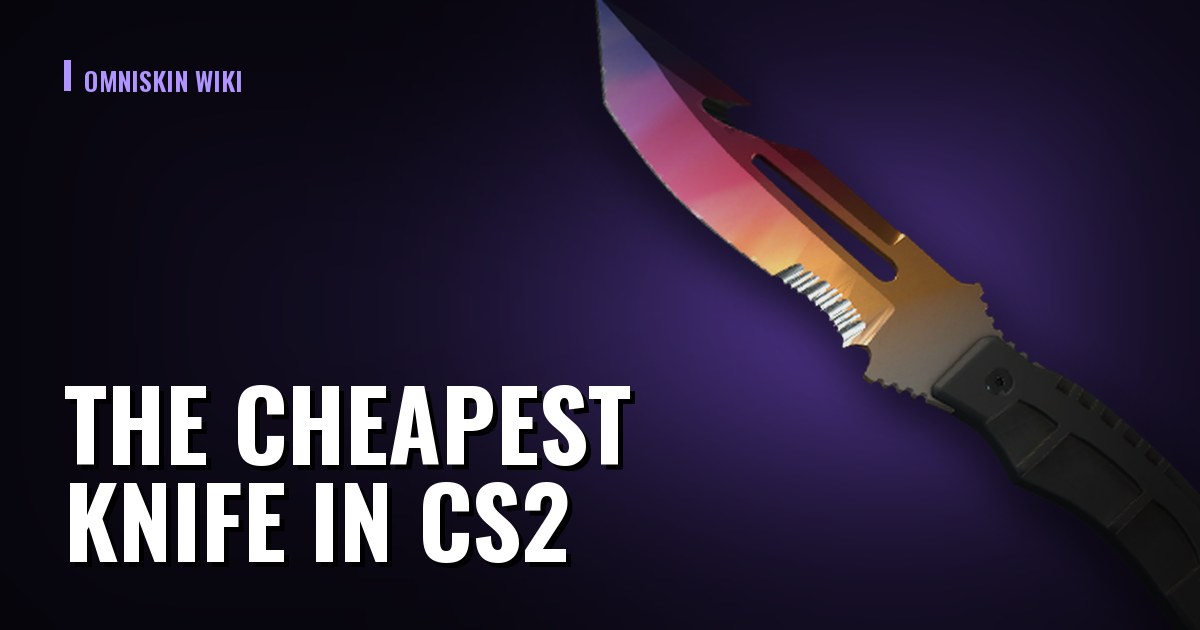
The Cheapest Knife in CS2: A Live List and What to Save On
The list of the cheapest knives is built from our database when the page opens. We cover what sets the floor, why cheap knives are almost always the same few models, and which of the five price multipliers is safe to economise on and which is not.
The live list
Below are the cheapest knives currently on the marketplaces. The list is assembled from the database at the moment the page opens, so it does not go stale the way hand-made roundups do.
 ★ Navaja Knife | Rust Coat (Battle-Scarred)$28.29
 ★ Kukri Knife | Safari Mesh (Field-Tested)$30.33
 ★ Shadow Daggers | Rust Coat (Battle-Scarred)$33.98
 ★ Shadow Daggers | Bright Water (Field-Tested)$34.20
 ★ Shadow Daggers | Black Laminate (Field-Tested)$34.55
 ★ Navaja Knife | Safari Mesh (Field-Tested)$34.87
 ★ Survival Knife | Safari Mesh (Field-Tested)$35.27
 ★ Navaja Knife | Forest DDPAT (Field-Tested)$35.30
 ★ Survival Knife | Rust Coat (Battle-Scarred)$36.40
 ★ Paracord Knife | Safari Mesh (Field-Tested)$36.56
 ★ Paracord Knife | Rust Coat (Battle-Scarred)$37.05
 ★ Survival Knife | Boreal Forest (Field-Tested)$37.42
 ★ Kukri Knife | Boreal Forest (Battle-Scarred)$37.45
 ★ Kukri Knife | Forest DDPAT (Field-Tested)$37.67
 ★ Paracord Knife | Forest DDPAT (Battle-Scarred)$38.17
Live prices: the list is built when the page opens
Only knives are listed; gloves are excluded because their pricing logic differs. Every price is confirmed by at least two marketplaces: a lone price too often turns out to be a stub, and it would take the first row and ruin the list.
Why cheap knives are almost always the same models
Open the list on several different days and the contents will change while the set of models barely will. The bottom is usually held by Shadow Daggers, Navaja Knife, Gut Knife and their like.
The reason is not craftsmanship but demand. A knife's price is built from five multipliers — model, finish, wear, pattern and StatTrak — and the model sets the base. Karambit, Butterfly and M9 Bayonet are recognisable, their inspect animation is expressive, and people pay for that. Models with an unremarkable animation cost several times less at the same finish.
The second factor is the finish. The very bottom is occupied by camouflage and flat patterns: Safari Mesh, Boreal Forest, Forest DDPAT, Stained. They exist on almost every model, drop often and surprise nobody.
The third is wear. Battle-Scarred and Well-Worn barely spoil the impression on a cheap knife while lowering the price noticeably.
 ★ Survival Knife | Fade
 ★ Nomad Knife | Fade
 ★ Skeleton Knife | Crimson Web
 ★ Karambit | Case Hardened
 ★ Talon Knife | Doppler
Why a floor exists at all
Knives have a floor below which the price does not go, and it is held up by the arithmetic of drops rather than by taste. A knife arrives from a case as a rare special item with a 0.26% chance — roughly one in 385 openings. However many unattractive knives exist in the game, their total number is capped by the number of cases opened, and opening costs money.
Hence a curious consequence: the cheapest knife in the game costs more than the most expensive ordinary skin in many collections. Not because it is better, but because it is produced fundamentally more rarely. The rarity tier works literally here: it is about frequency of appearance, not about beauty.
The second brick in that floor is trade-ups. Since an update in late 2025 a contract of five top-tier items returns a knife or gloves, which gave cheap knives another source of demand: they are bought not to wear but as a reference for the value of a contract's output. That props the floor up further.
What is safe to economise on and what is not
This is the practical question, and the answer differs by multiplier.
Wear — safe to economise. On dark and camouflage finishes the scuffing is barely visible in game. The price gap between Field-Tested and Battle-Scarred can be substantial while the on-screen difference is not. This is the safest saving available.
Finish — safe to economise. If you like the model, a cheap pattern on it still delivers what knives are bought for: your own animation in your hands. Plenty of people take an expensive model with a cheap finish and stay happy longer than those who did the reverse.
Model — economise carefully. This is what you will see every round. Saving here is easy and regretting it is easier still, and selling back costs fees and time.
Pattern — not a saving at all. On cheap knives it barely affects the price, so there is nothing to save.
StatTrak — no need to economise. On cheap models the counter adds little and sometimes nothing.
The main mistake when buying a first knife is chasing the bottom row of the list. The cheapest knife in the tier is cheap because few people want it, which means there will be nobody to sell it to. A ten-dollar gap between "the cheapest" and "a cheap one people actually buy" repays itself the moment the knife stops appealing.
How to pick a first knife without overpaying
Choose the model before the finish. Hold the knife in a private match through the console — it is free and takes a couple of minutes. Once the model is settled, look at its cheap finishes in this list and across marketplaces. Open the inspect link of the specific listing: copies inside one wear category look different. Compare the price across several marketplaces. On knives the gap between venues is wider than on ordinary weapons. Budget the exit: in our measurements an instant buyout returns a median of 81% of the listing price, and 91.1% of the rows on any marketplace are offers rather than trades.
Check the float and pattern of a specific listing:
🔧Check float & patternfree, no sign-upWhat this list does not contain
The limits are worth knowing so no wrong conclusion gets drawn.
No knives without trades. If nothing changes hands on an item, it does not enter the list — a low price with no buyer is not cheapness.
No gloves. Formally the same top tier, but a different market: wear shows more there, and for some series Factory New does not exist at all.
No account of pattern. The list is sorted by price, not by the beauty of a number. On cheap knives that hardly matters, but on expensive finishes like Case Hardened the pattern is what sets the price.
No forecast. The list shows where the floor sits now and says nothing about where it will sit in a month.
If you want a knife just to have one, take a popular model with a cheap finish in poor wear. If you want a knife as an investment, do not buy a cheap one at all: the bottom of the market has neither liquidity nor upside, only a low price.