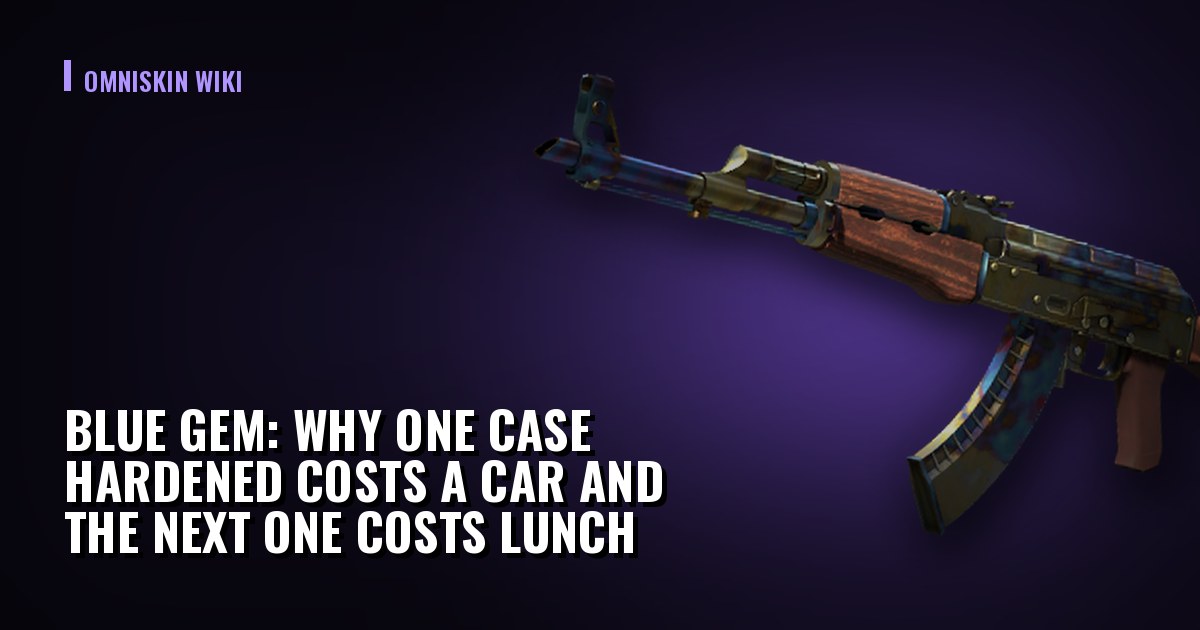
Blue Gem: Why One Case Hardened Costs a Car and the Next One Costs Lunch
On Case Hardened the price is set by how the blue lands, not by wear — and that comes from the seed, which the item name never shows. We cover playside and backside, which seeds are considered top tier, how blue gems differ from Doppler phases, and how to check a specific copy.
Two identical names, a hundredfold difference
Two items in an inventory. Both are called AK-47 | Case Hardened (Field-Tested), both have similar wear, both came out of the same case. One is worth about a hundred dollars, the other tens of thousands.
The item name does not tell them apart. The wear is nearly the same. What tells them apart is how the paint landed — the exact way blue, gold and grey fell across that particular rifle. It is assigned once, when the item drops, and can never change afterwards.
Case Hardened is the best known instance of a market paying not for an item but for a copy. The more clean blue it carries, the more it is worth, and the gap between "almost entirely blue" and "blue in patches" is measured in orders of magnitude, not percentages.
The key idea worth reading on for: on Case Hardened the price is barely tied to wear at all. A beaten-up copy with a top pattern is worth many times more than a pristine float with an ordinary one. That inverts the usual "lower float means higher price" logic.
 AK-47 | Case Hardened (Field-Tested)best price: $218.89 · lis
What a seed is, and why the name never shows it
Every CS2 item carries a hidden number — the paint seed, usually just "seed" or "pattern". The game assigns it randomly on drop, there are roughly a thousand possibilities, and it decides how the texture lands on the model.
For most skins the seed means nothing: every Redline looks the same. But on finishes where the texture is not a repeating print but a unique wash of colour, the seed becomes the dominant price factor. Case Hardened is the most expensive example of such a finish.
What matters here is that the seed is not stored in the name and not shown anywhere in the Steam interface. Not in the inventory, not on the listing page. To learn the seed of a specific copy you have to decode its inspect link — the same one that opens the item in game.
🔧Patterns: blue gem, fade%free, no sign-upPlayside and backside
Blue coverage is measured separately for the two sides of the model.
Playside is the face the player sees on their own screen during a match. It carries most of the price: a buyer pays for what they will be looking at themselves.
Backside is the reverse. Other players and spectators see it, and it matters on resale, but it is worth noticeably less. A copy with an excellent playside and a mediocre backside stays expensive; the reverse almost never does.
So "blue percentage" is always two numbers, never one. A listing quoting a single percentage without naming the side is usually showing the better one and staying quiet about the other.
Blue percentages are not computed by the game itself. The community measures them from model renders, by hand or semi-automatically. Different catalogues give slightly different figures for the same seed, and that is normal. What is worth comparing is a seed's rank within one catalogue, not absolute percentages pulled from different ones.
Top seeds and what each is known for
A seed's rank is its place in the blue-coverage list within its own weapon. Absolute percentages are not comparable across weapons: a knife and a submachine gun have different model geometry, and "60% blue" means different things on each.
| Weapon | Top seeds | What they are known for |
|---|---|---|
| AK-47 | 661, 387, 321 | 661 is treated as the benchmark number one: near-solid blue across the magazine and receiver |
| Karambit | 387 | the rarest blue gem in the game; pristine copies have changed hands for a million dollars and beyond |
| MAC-10 | 667, 114, 406 | the three leaders by blue coverage |
| Five-SeveN | 278 among others in the catalogue | the pistol has its own scale, ranks must be read separately |
| Bayonet | per catalogue | ranks differ from the Karambit despite the similar finish |
The numbers above are community reference points, not a price list. A seed determines what a copy looks like; what people pay for it today is a question of demand, and that moves.
Gold gems, the other direction
Where some hunt maximum blue, others hunt maximum gold. Those copies are called gold gems. Demand for them is markedly narrower: fewer buyers, harder resale, and a slimmer premium over an ordinary copy. It is a niche, not a second mainstream market.
How blue gems differ from Doppler phases
These two get confused constantly, and the mechanics behind them are different — the confusion costs money.
| Case Hardened (blue gem) | Doppler (phases) | |
|---|---|---|
| What decides the look | the paint seed | the paint index |
| How many variants | roughly a thousand, on a continuous scale | a few fixed variants |
| How to determine it | measure colour area from a render | read the index, the variant follows unambiguously |
| Room for argument | yes, catalogues disagree on percentages | no, a variant is either one or the other |
On Doppler the phase is set by the paint index, not the seed. "Working out the phase from the seed" is therefore guesswork: within a phase the seed only shifts how the shades are laid out. Case Hardened is the mirror image: the index is the same for everyone, and it is the seed that separates copies.
The practical consequence for a buyer: with a Doppler, learning the variant closes the question — a Ruby is a Ruby. With a Case Hardened, learning the seed is not enough; you also need where that seed ranks within its own weapon. The same number on different weapons means completely different things.
Checking a specific listing before buying
The sequence that saves money.
- Take the inspect link from the listing. Every item on a marketplace and in an inventory has one.
- Decode it and get the seed. The listing title and price contain no seed — it has to be pulled separately.
- Look up where that seed ranks for that weapon. Not an abstract percentage, but a position: top, middle, or ordinary.
- Look at the item itself, in game or on a render. Numbers describe but do not replace the picture: two seeds adjacent in rank can look further apart than their percentages suggest.
- Compare the price against ordinary copies of the same skin. A pattern premium should read as a markup over the base, not as "an expensive listing".
A common trap on marketplaces: the listing title says "blue gem", and the seed turns out to be unremarkable when checked. The words in a listing title are written by the seller and nothing verifies them. The only source of truth is the seed of the copy itself.
Our rank data covers five models: AK-47, Five-SeveN, MAC-10, Karambit and Bayonet. For other Case Hardened weapons no rank is derived — there, visual judgement from a render is what remains.
Why any of this is worth money
For an ordinary skin, supply is bounded by drops: copies are plentiful and interchangeable, and the price settles where demand meets inflow.
For a top seed, supply is bounded by arithmetic. If a seed is one of roughly a thousand, and copies carrying it in the wear you want number a few dozen across the entire history of the game, then this item has no market so much as a list of known owners. Every trade becomes an event that everyone involved hears about.
Two consequences follow, and both matter before buying.
Liquidity is close to zero. A top pattern cannot be sold quickly at any sensible price. Finding a buyer for such a copy takes weeks or months, and is harder than finding the money.
The price is not set by a listing page. An ordinary item has a median of completed sales to anchor to. A rare pattern sees a handful of trades a year, and a "market price" in the usual sense does not exist — there is the last known sale and an agreement between two people.