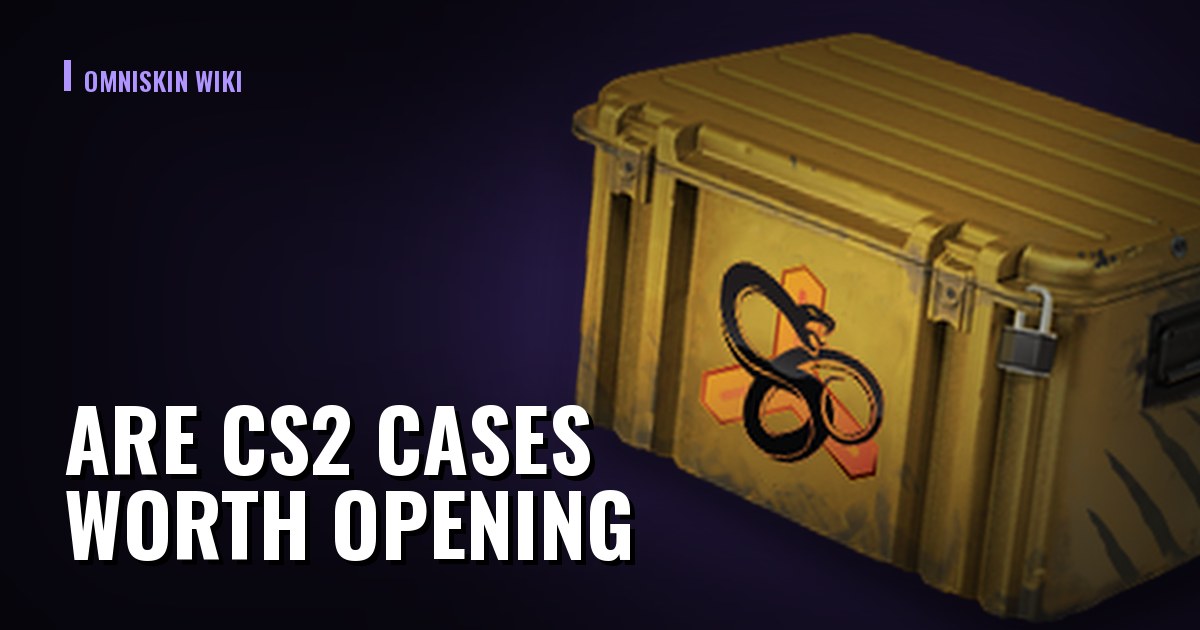
Are CS2 Cases Worth Opening? The Math, Not the Hope
The expected return of an unboxing: odds by tier, the cost of a key, why opening loses money on average, and when holding the case beats opening it.
Opening a case is a lottery with published odds. You can do the arithmetic, and it comes out the same for everyone: on average an opening returns less than it costs. Here is why, and what to do about it.


What an opening costs
Two things are needed to open a case: the case and a key.
- The case costs anywhere from a few cents to a few dollars, depending on whether it still drops in game or has left the active drop pool.
- The key has a fixed price of $2.49 and is bought from Valve only. Keys bought today cannot be traded, sold or gifted — that has been the rule since October 2019, and older keys still change hands well above their shop price.
So the floor on a single opening is about $2.50 plus the price of the case — before we even look at what comes out.
 Snakebite Casebest price: $0.31 · skinport
The odds
| Tier | Chance | Roughly one every |
|---|---|---|
| Mil-Spec (blue) | 79.92% | about 4 in 5 |
| Restricted (purple) | 15.98% | about 1 in 6 |
| Classified (pink) | 3.20% | about 1 in 31 |
| Covert (red) | 0.64% | about 1 in 156 |
| Knife or gloves | 0.26% | about 1 in 384 |
On top of that, roughly one in ten items arrives with a StatTrak counter.
Why it is negative on average
Expected return is simple to compute: sum up "item price × its chance" across everything in the case. Take a typical modern case at $0.60 plus the $2.49 key — $3.09 in. Blue lands 79.92% of the time and is worth cents on most cases, purple 15.98% at a couple of dollars, and the pink, red and knife rows are too rare to carry the average. The sum usually lands near half to two thirds of what you spent, before the fee on selling whatever dropped. The problem is structural:
- four openings out of five give a blue item, which on most cases is worth cents — so nearly every time you get back a small fraction of what you spent;
- the red tier and the knife happen so rarely that their high prices do not offset the stream of cheap outcomes;
- and whatever drops still has to be sold, which costs a fee.
That is why the calculation for almost any case puts expected return clearly below the cost of opening. Individual lucky hits do not change it — they are that fraction of a percent in the table.
The profit in cases goes to whoever sells the cases and the keys, not to whoever opens them.
When opening still makes sense
- For entertainment, with a budget you do not mind losing. That is payment for the thrill, not an investment.
- When you want one specific cheap item — buying it on the market is almost always cheaper than unboxing it.
What definitely does not work is "winning it back" with another ten openings. Odds have no memory: the hundredth opening has the same 0.26% knife chance as the first.
Holding a case beats opening it
An unopened case has a property an opened one does not: its supply can end. Once a case leaves the active drop pool, the inflow to the market stops while consumption continues — some cases are destroyed by opening. Historically such cases have appreciated at roughly 18–35% a year, on third-party estimates rather than audited data.
By opening a case you exchange an asset with limited supply for a random item whose expected value is below your cost. Since knife and glove prices roughly halved in the October 2025 crafting update, the top of that table pays less than it used to, which pushed the expected return of unboxing down with it. That logic is covered in the article on cases as an investment.
 Fracture Casebest price: $0.35 · skinport
Why "I got lucky" does not cancel the arithmetic
Everyone who has opened cases knows the story about a knife on the tenth spin. Those stories are real — and they tell you nothing about whether you should be opening.
The reason lies in the shape of the distribution. The average outcome is made up of a huge number of cheap results and a vanishing number of expensive ones. Because of that the typical result is far worse than the average: more than half of openers never reach the mean, because the mean is carried by the rare knives they will not see. Put simply, the average result does not go to the average player.
The second reason is survivorship bias. A knife screenshot gets posted; a hundred ten-cent skins do not. The feed you see is made of wins by construction, and you cannot judge odds from it.
The third is irreversibility. A case you opened is no longer a case: it became an item, usually worth less than the key. There is no reverse operation, and that separates opening from any trade you can undo by selling.
What to do with the cases you already have
On most accounts cases accumulate on their own from weekly drops, so the real question is not "should I buy" but "what do I do with these".
Option one: sell. Instant money, no variance, and the best answer if the cases are simply in your way.
Option two: hold. Cases removed from the active drop pool stop entering the market, while part of the existing stock is destroyed by opening every day: supply shrinks by itself. This is the only scenario where a case works as a position rather than a lottery ticket.
Option three: open. Reasonable if you understand you are paying for entertainment and the amount you are willing to lose was named in advance.
What to check before opening
- The price of the case and the key — those are your costs.
- The prices of the items inside, especially the blue tier, which lands 80% of the time.
- The selling fee — whatever drops still has to become money.
- The market price of the case itself — sometimes selling it beats opening it.